Product
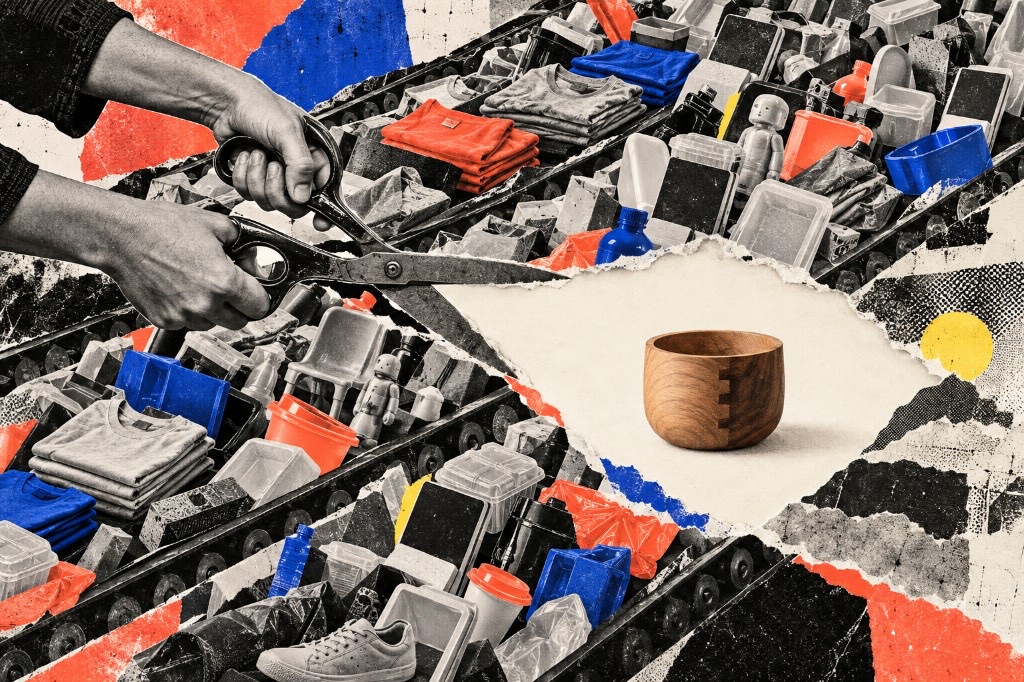
Fast food. Fast fashion. Fast product.
AI is making it easier than ever to create products quickly. Lately it’s reminding me of consumer culture.
We now live in a world where almost anything can be manufactured instantly and cheaply.
Fast fashion that loses its shape or color after three washes.
Endless Amazon search results filled with near-identical objects made with cheap materials.
Flimsy furniture that lasts two years because it’s made from particle board, or is it cardboard?
Products we don’t really need and that will end up in a landfill a month from now.
Products optimized for speed and scale like fast food with questionable ingredients.
Manufacturing is becoming quite easy.
And while that unlocked incredible access, scale, and wealth, it also flooded the world with things that feel hollow.
Mass-produced. Forgettable. Disposable.
Slops.
And honestly, parts of the AI world are drifting toward the same thing.
We can now generate almost anything instantly: screens, illustrations, apps, presentations, code, prototypes, copy, entire products.
And as a designer, I have to admit, it’s incredibly exciting.
But much of it lacks intentionality.
It lacks restraint. It lacks clarity. It lacks care and that extra mile that creates authenticity and quality.
It’s a somewhat polished surface that’s empty underneath.
Know what NOT to make
One thing design school and various experiences at early stage startups have taught me is that constraints shape quality.
Limited time, limited knowledge, and limited resources force people to prioritize brutally.
Constraints make people care deeply about what actually matters.
AI changes that dynamic completely because it opens up so many amazing possibilities.
The speed to generating another idea, another variation, another screen, or another prototype is approaching zero.
And when generation becomes fast and cheap, a new skill becomes valuable:
Discernment and knowing what not to make.
Care about the craft
This is why I believe craft matters more in the AI era. Not less.
Judgment matters more. Curation matters more. Taste matters more.
And I don’t just mean “taste” aesthetically.
I mean taste as:
- knowing what feels right
- knowing what deserves attention
- knowing what should remain simple
- knowing when to stop
- knowing what to cut
- knowing what not to ship
- knowing the little details that make a big difference
AI can generate whatever.
But meaningful products require intentional experiences.
They require people who understand nuance, context, emotion, pacing, and restraint.
Because the best products were never just functional.
They were thoughtful.
Great work has always come from people who care about the details no one else notices — not from people looking for shortcuts.
Be an editor in this era
When everyone can generate polished outputs, the differentiator is no longer: “Can you make something?”
It becomes: “Can you make something worth caring about?” This is something I’ve been thinking about deeply as I’ve been wrapped in the thrill of creating fast products.
I think the people who thrive in this era won’t simply be the fastest producers.
They’ll be the best editors. The best curators. The ones who have deep human creative instincts. The ones who have backgrounds in the humanities, psychology, storytelling, philosophy, and even art.
And the ones who can:
- tell what matters from what doesn’t
- simplify complexity
- cut ruthlessly
- maintain taste under infinite possibility
- bring that human feel into systems
So while AI can help us create fast products — like fast food and fast fashion — that doesn’t mean they’re good.
Let’s create great work. Great products.
Let’s use AI to move faster. But let’s not confuse speed with quality.
The future won’t belong to the people who can make the most things.
It will belong to the people who know what is worth making in the first place.