Product
How to build your product intuition
I remember back at Vault.fm, every interview — whether for an engineer, designer, or PM — included one assessment from David Greenstein, the cofounder and CEO:
Does this person have product intuition?
It mattered because we were working in a new space, trying to pioneer what music and community could look like in web3. There wasn’t much data. No established playbook. Just instinct, curiosity, and conviction guiding the work.
That experience taught me early how powerful intuition can be, especially when you’re building something that doesn’t have a map yet.
Recently, I’ve been designing for a brand-new product — true 0→1 work.
The PRD was still evolving, but I could already feel the shape of the experience forming. So I moved quickly from sketches to wireframes to early flows — just enough to give the team something tangible to react to, so we could align on the core concepts.
Then the questions started rolling in:
“Why is this structured this way?” “What was your process here?”
On the surface, these were completely normal design critiques. But underneath, I sensed something else… a quiet doubt. Almost like the work looked rushed or not fully thought out.
What they didn’t see was everything happening behind the scenes — the silent calculus built over years of designing.
When you’ve shaped many products, you don’t always need to diagram every decision or label every sticky in FigJam to move your thought process forward. You start to sense patterns. You anticipate friction. You carry a mental library of user behaviors and design outcomes that quietly guides your thinking.
That early wireframe wasn’t thoughtless. It was intuition — product intuition.
It might not have been perfect or final, but it was grounded in logic, formed through hundreds of past design decisions, mistakes, and lessons learned.
That moment reminded me how rarely we talk about intuition as a real, essential part of product design. Yet it’s one of the most underrated skills in product builders — not visual, technical, or strategic. Intuitive. And it’s something any builder in tech can develop.
So what is intuition, really?
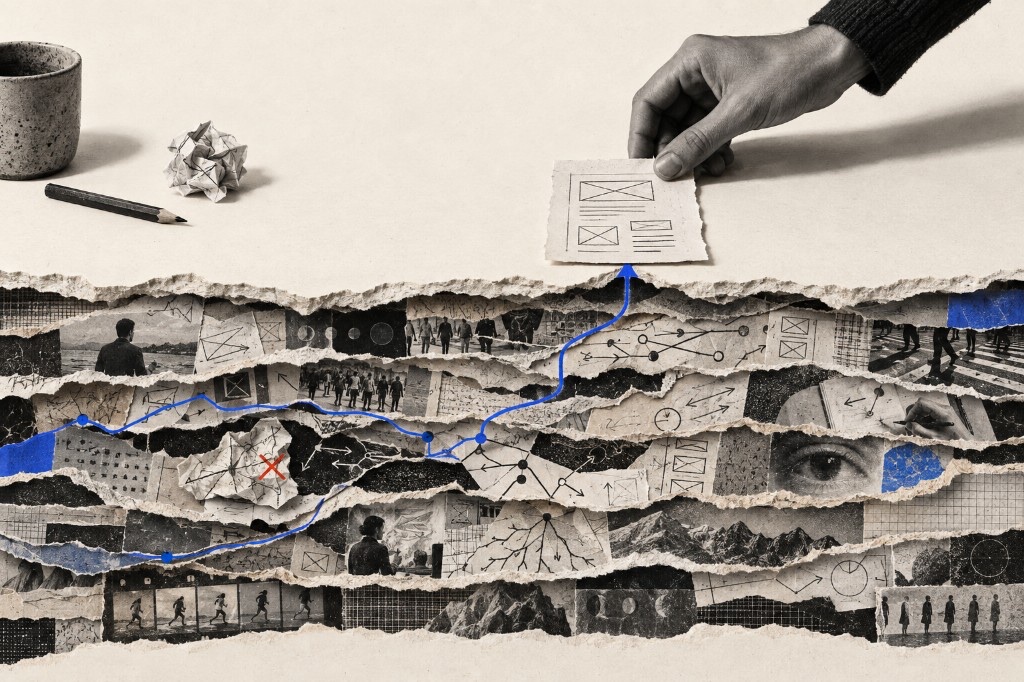
We often treat intuition like a mystical “gut feeling.” But intuition is really just compressed experience. Your brain recognizing familiar patterns before you can consciously explain them.
It’s fast. It’s subconscious. It’s built from exposure. Intuition isn’t magic. It’s memory, disguised as product instinct.
Product intuition is your ability to make reliable design decisions quickly, even with incomplete information.
It’s knowing what users will care about. What will feel simple versus confusing. What to prioritize or refine now versus later. What’s just unnecessary noise. What will scale — or break.
It’s not guessing. It’s practiced judgment, refined through reps.
Why it matters
In a world drowning in dashboards, frameworks, and AI insights, it’s easy to get paralyzed waiting for perfect data.
And when you’re designing something entirely new, there often isn’t any data yet. You’re building in a space that’s messy and undefined, where every move feels like a guess.
That’s when intuition matters most.
When the path isn’t clear, your intuition helps you sense direction, notice what’s useful amid the clutter, and see patterns forming before they fully exist. It guides you through ambiguity and gives you the confidence to keep going when there’s no playbook to follow.
Product intuition helps you move without waiting for a committee. It helps you know which details actually matter. It helps you sense what users are trying to do. It helps you trust your instincts in uncertainty — and explore beyond what’s already been validated.
Data validates decisions. Intuition guides them. The best designers use both, but in early product work, intuition often leads the way.
How to build it
You can’t read your way into intuition. You build it through action, exposure, and reflection… the same way wisdom comes with age.
Here’s what has worked for me:
1. Ship more than you’re comfortable with
Every product you ship becomes a mental datapoint. Velocity accelerates pattern recognition. Shipping is how you feed your intuition.
2. Get things wrong on purpose (and study them)
Your intuition grows fastest when you’re wrong. And I have been wrong many times. Mistakes teach you where assumptions failed, what users actually do, and which details mattered most. Every failed experiment becomes a subconscious lesson that sharpens your instincts for next time.
3. Live inside your user’s world
You can’t build intuition from a distance. Use the product. Dogfood it. Be the user. Break it. Know it inside out. Find the friction. Experience the awkward flows and rough edges yourself. Great design intuition is built on embedded empathy — by feeling what your users feel.
4. Seek out unfamiliar problems
The best designers have range. They don’t see only one type of pattern because they don’t solve only one type of problem. Study other apps, unexpected UX choices, behavior in other industries, and how trends shift user expectations. The more patterns you see, the sharper your instincts become. Competitive and landscape analysis matters — but don’t only stay within your own industry. Explore beyond it to understand what works and what doesn’t.
5. Then stop and reflect
That’s where intuition blooms. Intuition doesn’t come from doing alone. It comes from processing what you did and how you did it.
After each project, I try to ask:
- What was my initial instinct?
- What did I get right and wrong?
- What would I do differently next time?
Reflection turns repetition into wisdom.
Product intuition isn’t something you’re born with. It’s something you earn.
Through curiosity. Repetition. Mistakes — and lots of them. And the courage to design before you feel “ready.”
The more you ship, the more patterns you collect. The more patterns you collect, the stronger your intuition becomes.
What people call your “gut feeling” is often just your accumulated design experience, speaking a little faster than you can explain it.